What Is the Quantity Used to Measure an Objects Resistance to Changes in Rotational Motion?
Costless style skiers are able to rotate several times most longitudinal and transversal axes during a single jump. How is it possible that during a single jump they are able to rotate their body with skis on their feet, to speed up that rotation or tedious it down, and to rotate very slowly soon before their landing? How are gymnasts, figure skaters and other athletes able to increase and decrease the speed of their rotation without beingness in contact with the ground? Why do athletes use rotating technique in hammer throw? In the post-obit chapter we volition endeavour to present a theoretical ground for answering such questions.
Inertia of rotating bodies
An object's resistance to changes to its rotation is chosen the inertia of a rotating body. In bodies with more rotational inertia it takes more energy to increase or decrease their angular velocity or to change the position of their axis of rotation. A heavier bicycle wheel will resist motion at the start and, on the other paw, will be hard to stop in finish compared to a lighter bicycle. Only people with outstanding sense of residual are able to stay motionless on a bicycle, while practically anybody tin can keep rest on a moving bicycle. Behind all these phenomena there is inertia. Heavier wheel has more inertia because its mass is bigger. Moreover, while rotating the wheel resists any changes to the position of its centrality of rotation – that'southward why it is so much easier to keep balance on a moving wheel.
The measure out of inertia results not merely from the mass of the body but besides from the style its mass is distributed in relation to the axis of rotation. A stroke with a longer golf social club is more difficult than a stroke with a shorter lodge.
Moment of inertia
Moment of inertia is a measure of an object's resistance to changes to its rotation:
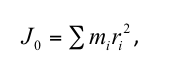
where J 0 (kg⋅one thousand2) is moment of inertia in relation to the axis going through the heart of gravity, Σ is a symbol of sum, one thousand i (kg) is the mass of the i th element of the body (eastward.g. segment of a human body), and r i(m) is the altitude of the i th element of the body from the axis of rotation that goes through the centre of gravity.
Each segment of a human trunk resists changes of rotary motion. Measure of such resistance is product of the mass of a segment and the square of its distance from the axis of rotation, i.east. moment of inertia.
While inertia of bodies in linear motion only depends on i quantity (mass), inertia of rotating bodies depends on 2 quantities (mass and the distance of the chemical element from the axis of rotation – characteristic of the distribution of mass around the axis of rotation). These two quantities practise not have the aforementioned influence on moment of inertia. The influence of mass on the inertia of rotating bodies is much smaller than the influence of the distribution of mass. Increasing the mass twice volition only increase moment of inertia twice, but increasing the radius of gyration64 twice will increase the moment of inertia of the given body four times. For example the length of a baseball bat has much larger influence on the time needed to strike a projectile (a ball), using identical technique, than the mass of the baseball bat.
When using sporting equipment (bats, rackets, clubs, sticks, etc.) nosotros produce forcefulness that rotates these pieces of equipment about an axe that does not become through their eye of gravity. Such moment of inertia can be calculated as:
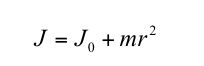
where J (kg·m2) is moment of inertia in relation to the axis that is non going through the centre of gravity, J 0 (kg·mtwo) is moment of inertia in relation to the axis going through the centre of gravity, grand (kg) is the mass of the body (equipment), and r (grand) is the distance between the axis of rotation and a parallel centrality going through the centre of gravity of given body. This ways that moment of inertia of a body in relation to an axis that is not going through the centre of gravity is e'er bigger than moment of inertia in relation to an axis that is going through the centre of gravity and is parallel to it.
When assessing qualitatively the resistance of a body to a change of rotation in sporting exercise, the distance of the mass of the trunk from the axis of rotation is the most important factor influencing the inertia of the given rotating body.
Each trunk has infinitely many possible moments of inertia considering it tin rotate well-nigh infinitely many axes of rotation.
In physical education and sport we generally use three major axes to evaluate motion: Anteroposterior (cartwheel in gymnastic is performed about anteroposterior axis), transversal (somersaults are performed about transversal axis), and longitudinal (pirouettes are performed nearly longitudinal axe).
Intentional alter of moment of inertia of a human body
Human trunk is non solid because individual segments of human being trunk tin move in relation to each other. For this reason the moment of inertia of human being body in relation to i axis is a variable quantity. This ways that we tin can intentionally change moment of inertia of our trunk so that it is advantageous for achieving improve sporting performance or managing a given motor job. Figure skater tin can more double his moment of inertia virtually longitudinal axis past abducting arms to the level of shoulders. Gymnast can decrease moment of inertia about transversal centrality in somersault to a half if he curls up tightly enough (Fig. 23). Sprinter flexes his knees and hip joints when he is increasing angular velocity of his legs past which he reduces moment of inertia of his leg in relation to axis of rotation going through hip joints.
Figure 23 Gymnast performing a complicated vault with double forrard somersault in squatting position in the second phase of his flying - Roche vault. Gymnast curls upward during the somersault to intentionally decrease moment of inertia.
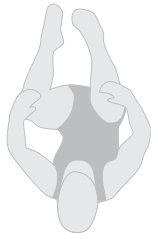
Gymnasts, figure skaters, athletes and many other sportsmen intentionally change their moment of inertia to perform motor skills with more efficiency.
Manufacturers of sport equipment also try to create products with such moment of inertia so as to facilitate more efficiency in performing motor skills. Downhillers utilize longer skis than slalom racers. Longer skis give skiers needed stability when moving with the velocity of approximately 100 km/h. Slalom racers demand skis to alter direction swiftly, i.e. skis with smaller moment of inertia about the centrality of the skier's rotation. Slalom racers therefore use shorter skis. Manufacturers of certain slalom skis fifty-fifty fill up the tips of the skis with light fabric to decrease their moment of inertia.
Moment of inertia and linear velocity
From the previous chapters we know that for case longer hockey stick produces higher velocity of the blade if we are able to strike with the aforementioned angular velocity. The puck will fly with higher velocity. Why then hockey players don't apply hockey sticks ii metres long? Unfortunately, if we make hockey stick longer, we also increment its moment of inertia which makes it much harder to increment the angular velocity of such hockey stick because more than free energy must exist used, i.e. more piece of work must exist performed. Hockey stick must therefore have optimum length so that it tin be used to strike with loftier velocity without having to overcome high inertia resistance. Influence of moment of inertia on velocity is present likewise in other equipment, such as golf clubs, lawn tennis rackets, baseball bats, etc.
Angular momentum
Angular momentum L (kg·m/due south) is defined every bit production of the moment of inertia J (kg·10002) of a body about an axis and its angular velocity ω (rad/due south) with respect to the same axis:
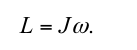
Unit of measurement of angular momentum is kg·thou/s. Athwart momentum is a vector quantity – it has magnitude and direction. The direction of the angular momentum is the same every bit the management of angular velocity that defines it.
Angular momentum of a rigid body
Athwart momentum depends on ii quantities, moment of inertia and angular velocity. For perfectly rigid bodies a change of moment of inertia depends on one variable quantity only – on angular velocity, because moment of inertia of rigid bodies does non change65. In bodies that are not perfectly rigid (human body) a change of angular momentum can be caused by both a alter to angular velocity and a modify to moment of inertia.
Angular momentum of human body
The sum of angular moments of private segments of human torso gives approximate value of angular momentum of the whole torso66. For instance in running right arm rotates forward while left arm rotates backward, and in the same manner legs rotate in contrary directions. Regarding the fact that angular momentum is a vector quantity and therefore the direction of rotation of the given segment virtually chosen transversal axis matters, angular momentum of the whole body in relation to transversal axis is zero67.
Estimation of Newton' commencement law for rotary motion
Athwart momentum of a given body is abiding unless non-zero resultant external moment of strength starts acting on it.
For sport practice this means that it is incommunicable to outset rotating homo trunk already later on take-off76. That is why coaches in gymnastics and acrobatics teach their charges to start rotating already at the moment of take-off. Newton' first law does not state that angular velocity must stay the same when no external moment of force is acting. Therefore the angular velocity of the torso tin can exist inverse later on the accept-off (during the spring), if we actively modify the body'due south angular momentum. Angular velocity of the body is then changed in such a way that the angular momentum after the have-off is always constant: L = Jω = constant. When for example a skier subsequently a badly done jump over a mogul decides to uncurl, he thus increases the angular momentum of his trunk in relation to his centrality of rotation and his angular velocity of rotation decreases and so that his angular momentum stays the same as at the moment presently after have-off. At the moment of landing the skier can be in such a position that he is able to continue his run and continue his rest without falling on his back. When rotating, human body can control the velocity of rotation by moving its torso segments; concentrating the mass of the body nearer to the axis of rotation will increase the velocity of rotation, moving the mass of the trunk further from the axis of rotation will subtract the velocity of rotation, with the same angular momentum69.
Some other very typical example of using intentional change of angular momentum in sport is the result of changing the velocity of rotation by figure skaters when doing pirouettes. Friction betwixt the ice and the skate is negligible and therefore the skater afterward accept-off tin rotate on one foot for quite a long fourth dimension. If the skater raises his arms upwards, his angular momentum is smaller than when he stretches his arms sideways. Angular momentum is product of athwart velocity and moment of inertia in relation to the centrality of rotation. During a take-off the skater gains athwart momentum which stays the same until some other take-off70. A decrease in moment of inertia must therefore exist accompanied past an increase in angular velocity. Figure skater therefore decreases athwart velocity of his rotation by stretching his artillery sideways or increases athwart velocity of his rotation by property his artillery close to the body. For spectators it is very attractive to lookout endless variations of pirouettes with changing velocity as a part of varied fix of acrobatic elements.
Gymnasts, skiers, dancers, figure skaters, etc. control the velocity of rotation of their bodies by changing moment of inertia of their trunk in relation to the axis of rotation (curling – uncurling, abduction – adduction, etc.)
Interpretation of Newton' second law for rotary motion
Modify of angular momentum of a torso is directly proportional to the resultant moment of force which is acting on this torso and such change has the direction of the external moment of force.
For perfectly rigid bodies with constant moment of inertia about the chosen axis of rotation we can describe relations between kinematic and kinetic quantities equally follows:
If resultant external moment of force One thousand (N·yard) is acting on a body, the body gains angular acceleration ε (rad/sii) which has the direction of that moment of strength. Angular acceleration will be directly proportional to moment of external force and inversely proportional to moment of inertia J (kg·m2) of the body in relation to the axis of rotation:
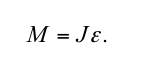
The above equation does not employ to bodies that are non perfectly rigid, such every bit human trunk. For man trunk the resultant external moment of forcefulness is equal to the rate with which athwart momentum changes:
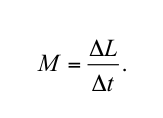
Resultant moment of external strength acting on a torso is directly proportional to the rate with which angular momentum changes.
Alter of athwart momentum tin take the following consequences:
- angular velocity decrease or increase
- change of position of the axis of rotation
- change of moment of inertia
Angular acceleration of a trunk or a change of moment of inertia does non necessarily mean that an external moment of strength is acting on the body, because the total athwart momentum of a body that is not perfectly rigid can stay constant even if the body accelerates or if its moment of inertia changes
Angular impulse and athwart momentum
Angular impulse equals a modify of angular momentum. The measure of such alter of angular momentum depends on the duration of the moment of force and its magnitude. Longer moment arm produces greater moment of strength, every bit we already mentioned. Increasing duration of the moment of strength seems to be an easier way of increasing the angular momentum but in sport time is an important factor and in certain situations cannot be prolonged at volition. Yet, in exceptional cases it is possible. Figure skater, for instance, rotates about longitudinal axis past standing on the tip of one skate and pushing confronting the ice with the other skate. Pushing leg should be as far every bit possible from the longitudinal axis to create greatest possible moment of force. If the effigy skater arranges his torso in such a manner that his moment of inertia in relation to longitudinal axis is as small as possible, he tin can have sufficient dispatch at take-off. At another take-off he already has high athwart velocity and thus less fourth dimension for pushing against the ice. The skater tin therefore uncurl his torso to increment moment of inertia shortly before take-off. Greater moment of inertia results in lower angular velocity nigh the longitudinal axis and thus in more time for have-off. The longer the skater is acting with force during accept-off, the greater athwart impulse is bestowed and the greater alter of angular momentum will occur.
Similarly discus throwers assume a position with maximum moment of inertia at the beginning of the throw while at the cease of the throw, at the moment of releasing the discus, their moment of inertia is much smaller. In activities where the goal is to rotate with maximum velocity athletes assume a position with maximum moment of inertia at the kickoff to be able to human action with moment of force for a longer time and maximize athwart impulse and thus the change to angular momentum. As soon as a sufficient angular momentum is created, athletes assume a position with smaller moment of inertia and thus increase the velocity of rotation at the right moment, for example at the moment of releasing discus.
Interpretation of Newton' third constabulary for rotary movement
Moment of force by which the beginning body acts on the second body produces moment of forcefulness of equal magnitude past which the second body acts on the outset trunk at the same time simply with contrary management. We must also not forget that these moments of force have the same axis of rotation. Effect of these moments of strength is dissimilar because they human action on different bodies. A adept example of the employ of Newton' third constabulary for rotary move is the moment of force produced past quadriceps femoris (specifically vastus femoris) during extension of articulatio genus joint. When these muscles contract a moment of forcefulness is produced which rotates shin in one direction and at the aforementioned time some other moment of force is produced, with equal magnitude but contrary management, which rotates thigh. These two opposite rotations produce extension in knee joint.
Comparing of kinetic quantities of linear motion and rotary motion
Table 4 is useful for comparing kinetic quantities of linear motion and rotary motility. Here we tin observe the sum of knowledge of linear movement and rotary movement kinetics, to compare their differences and to realize in what aspects these 2 types of movement are like.
Table four Comparison of kinetic quantities of linear motion and rotary motion.
| Linear motility | ||
| Quantity | Symbol used and basic equation | SI unit |
| Mass | m | kg |
| Force | F | Due north |
| Momentum | p = mv | kg·m/southward |
| Impulse of forcefulness | I = ΣFΔt | N·south |
| Rotary motion | ||
| Moment of inertia | J = Σmr2 | kg·m2 |
| Moment of roce | G = r 10 F | N·m |
| Athwart momentum | L = Jω | kg·m2/s |
| Angular impulse | H = ΣMΔt | N·chiliad·south |
64 Radius of gyration is a distance that states how far from the axis of rotation the complete mass of the body would have to be full-bodied in society to produce equal resistance to changes of rotary motion equally the given body in its original course, i.e. in order to take the same moment of inertia.Zpět
65 Bold fixed position of axis of rotation in relation to the body.Zpět
66 The verbal calculaiton of angular momentum of human torso in relation to axis going through eye of gravity is equally follows: L = Σ(J i ω i + m i r ii i/cg ω i/cg), where i is a segment of man body and cg is center of gravity.Zpět
67 In technically well performed run for longer distances trunk should not rotate or lean.Zpět
68 With the exception of situatons where man body starts to rotate nether the influence of resistance of the environment (water, air). The cause of this then-called secondary rotation is Coriolis forcefulness, produced by a segment of a man torso moving outside the relevant plane of trunk rotation.Zpět
69 Angular momentum stays the same if no resultant external moment of forcefulness is acting on the human body, produced by a contact of the human body with some other body.Zpět
seventy If friction is neglected.Zpět
Source: https://www.fsps.muni.cz/emuni/data/reader/book-2/31.html
0 Response to "What Is the Quantity Used to Measure an Objects Resistance to Changes in Rotational Motion?"
Post a Comment